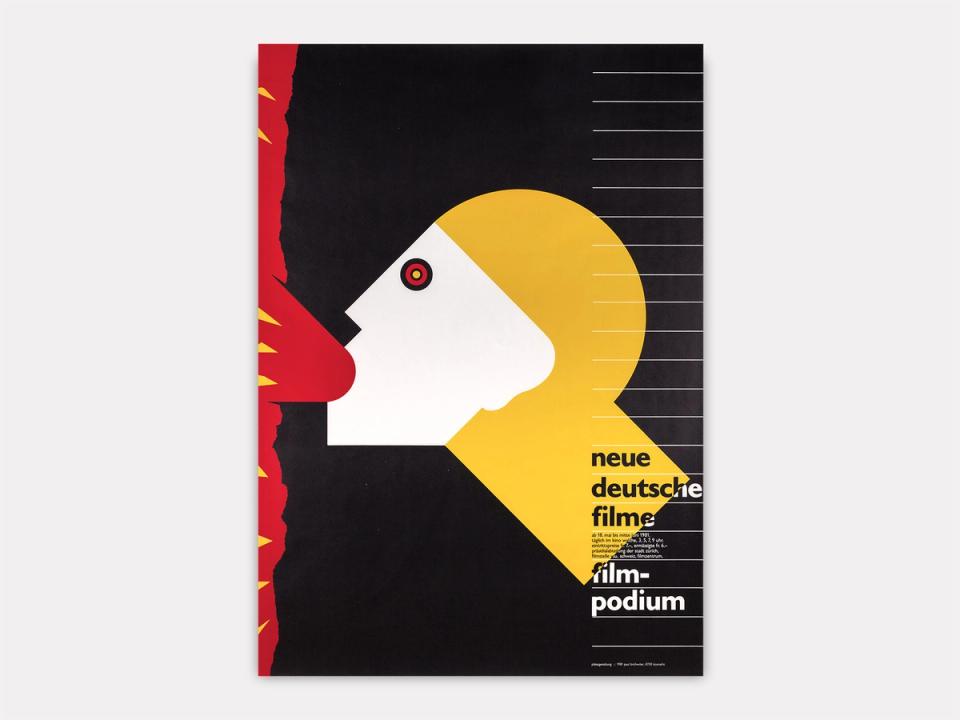
Paul Brühwiler
Neue deutsche Filme.
Filmpodium, Zürich, 1981
The Eye as a Target – A Metaphor for Critical Vision
Description: Publisher: Filmpodium Zürich, 1981. Printer: Spillmann Siebdruck, Zürich. Technique: Serigraphy. Size: 128 × 90 cm (F4) – 50½ × 35½ in.
Ref.: Brühwiler (1999); Tön 350544
Condition: An original poster in very fine condition, with no significant or at most slight signs of use commensurate with its age, such as slight folds, tears or bubbles. Not mounted.
Notes: The poster advertises a film series on the New German Cinema, a movement that took shape in 1962 with the Oberhausen Manifesto (“Dad’s cinema is dead”) and produced renowned directors such as Rainer Werner Fassbinder, Werner Herzog, Wim Wenders, Alexander Kluge and Margarethe von Trotta. Due to its minimalist aesthetic, Brühwiler’s poster can be classified as one of his most radical works of this kind. The highly abstract depiction of the human head clearly echoes the works of Oskar Schlemmer at the Bauhaus, as well as to the mechanistic, geometric representations of the face by Kandinsky or Moholy-Nagy. The eye, depicted as a target, is strongly reminiscent of the constructivist motif of the ‘eye-camera’ principle, as manifested, for example, in Dziga Vertov’s 1929 film “Man with a Movie Camera”. Furthermore, parallels can be drawn with political posters of the 1920s in which the eye was depicted as a means of perception, enlightenment, and surveillance. New German Cinema engaged critically with German history – in particular National Socialism and the post-war period – as well as with the social contradictions and upheavals of the 1960s and 1970s. This development was also reflected in the adoption of a spirit of narrative and visual experimentation, as was characteristic of German cinema in the 1920s. Brühwiler’s poster design also draws on the optimistic spirit of the Weimar era, thereby linking the two periods in a remarkable way.
---
Bibliography:
Brühwiler, Paul: Pabrü. Plakate, Bilder. Eigenverlag, 1999
Tön, Guido: Plakate von Paul Brühwiler 1980–1986. Zürich, 2018. p. 32, #350544